The Galician Context: Life Under the Habsburgs
To understand why hundreds of thousands of Ukrainians left their homeland between 1891 and 1914, we must first understand the world they left behind. The vast majority of these immigrants came from Galicia (Ukrainian: Halychyna), a province of the Austro-Hungarian Empire that encompassed much of what is today western Ukraine and southeastern Poland.
Galicia had been absorbed into the Habsburg Empire following the First Partition of Poland in 1772. Under Austrian rule, the province was divided into two distinct cultural zones: Western Galicia, predominantly Polish, and Eastern Galicia, predominantly Ukrainian (then commonly referred to as "Ruthenian" or "Rusyn"). The provincial capital was Lemberg (Lviv in Ukrainian, Lwow in Polish), a cosmopolitan city where Ukrainian, Polish, Jewish, Armenian, and German communities coexisted in an uneasy balance.
For the Ukrainian peasant majority, life in Galicia was defined by agriculture. Families worked small plots of land that had been divided and subdivided over generations until many holdings were too small to sustain a family. The average Ukrainian peasant farm in Galicia by the 1880s was less than five hectares -- barely enough to grow food for a household, let alone produce a surplus for market.
The social structure was rigid. The Polish szlachta (nobility) controlled most of the large estates and dominated the provincial administration. Ukrainian peasants were at the bottom of a hierarchy that kept them poor, poorly educated, and politically marginalized. Although serfdom had been formally abolished in 1848, the economic relationships between landlords and peasants changed slowly. Many Ukrainians continued to work on Polish-owned estates as labourers while struggling to feed their own families on their tiny plots.
Push Factors: Why They Left
By the 1880s, a combination of forces was making life in Galicia increasingly untenable for Ukrainian peasants.
Land Pressure and Overpopulation
The population of Galicia grew rapidly throughout the 19th century, from approximately 5.5 million in 1820 to over 8 million by 1910. Under the prevailing inheritance system, land was divided equally among sons, meaning that with each generation, individual holdings grew smaller. By the 1890s, a significant portion of Ukrainian peasant families were classified as landless or near-landless, owning less than two hectares. These families could not survive on farming alone and were forced to seek wage labour on large estates or in seasonal agricultural work.
Poverty and Taxation
Galicia was the poorest province in the Austro-Hungarian Empire. Contemporaries called it the "Ireland of Austria" for its grinding poverty. Taxation was heavy relative to income. Peasants owed taxes to the Austrian state, fees to the local administration, and tithes to the church. Poor harvests -- which were frequent in the marginal agricultural conditions of the Carpathian foothills -- could push families from poverty into destitution.
Limited Economic Alternatives
Unlike other parts of the empire, Galicia had very little industrial development. There were few factories, few mines, and few urban employment opportunities. Young men who could not make a living on the land had limited options: seasonal labour on sugar beet farms in Germany, military service in the Austro-Hungarian army, or emigration.
Political and Cultural Marginalization
Although the Austrian constitution theoretically guaranteed equal rights to all nationalities, in practice the Polish administration of Galicia ensured that Ukrainians had limited access to education, government positions, and economic advancement. Ukrainian-language schools were scarce, and the judicial and administrative systems operated primarily in Polish. This sense of being second-class citizens in their own homeland contributed to a willingness to seek a new life elsewhere.
Pull Factors: Canada's Call
While conditions in Galicia were pushing people out, Canada was actively pulling immigrants in. In the 1890s, the Canadian government embarked on one of the most ambitious immigration recruitment campaigns in history, specifically targeting agricultural settlers for the vast, sparsely populated prairies of Western Canada.
Free Land: The Homestead Act
The Dominion Lands Act of 1872 offered a quarter section (160 acres / 65 hectares) of prairie land to any settler willing to live on the land, build a dwelling, and cultivate a specified portion within three years. For a Galician peasant farming less than five hectares, the offer of 65 hectares of free land was almost incomprehensible. The fact that the land was free -- requiring only a $10 registration fee -- made Canada irresistible compared to destinations like the United States, where good farmland was becoming scarce and expensive.
Active Recruitment
The Canadian government did not simply wait for immigrants to discover these opportunities. It deployed immigration agents across Europe, including in Galicia, who distributed pamphlets, gave lectures, and answered questions about life in Canada. These agents painted a picture of boundless opportunity: rich soil, religious freedom, and the chance to own more land than a family could farm in a lifetime.
Steamship companies, particularly the Hamburg America Line and North German Lloyd, also recruited aggressively. Their agents operated in Galician towns and villages, selling tickets for the transatlantic crossing and acting as intermediaries between would-be emigrants and the Canadian immigration system. The steamship companies had a financial incentive to fill their ships, and they developed sophisticated networks of local agents who earned commissions for each ticket sold.
Clifford Sifton and the "Men in Sheepskin Coats"
No figure was more central to the Ukrainian immigration story than Clifford Sifton, who served as Canada's Minister of the Interior from 1896 to 1905. Sifton understood that settling the prairies was essential for Canadian sovereignty -- without a population to occupy the West, there was a real risk that the territory could be claimed or dominated by the United States.
Sifton was pragmatic about who he wanted. While many English Canadians preferred immigrants from Britain and northern Europe, Sifton famously declared that what Canada needed was "a stalwart peasant in a sheepskin coat, born on the soil, whose forefathers have been farmers for ten generations, with a stout wife and a half-dozen children." He was describing, almost perfectly, the Ukrainian peasant of Galicia.
Under Sifton's direction, immigration agents in the Austro-Hungarian Empire intensified their recruitment of Ukrainian and other Eastern European peasants. The results were dramatic. Between 1896 and 1905, the number of Ukrainian immigrants to Canada surged, transforming the demographic landscape of the prairies.
Not everyone welcomed the newcomers. English-speaking Canadians frequently expressed hostility toward Ukrainian immigrants, whom they considered backward, dirty, and culturally alien. Newspapers published hostile editorials. Some politicians questioned whether Ukrainians could ever be assimilated into Canadian society. But Sifton held firm. The prairies needed settlers, and the Ukrainians were proving to be exactly what the land demanded: hard-working, resilient, and deeply committed to farming.
The Pioneers: Wasyl Eleniak and Ivan Pylypiw
The story of Ukrainian immigration to Canada begins with two men from the village of Nebyliv in the Kalush district of Galicia: Ivan Pylypiw and Wasyl Eleniak. In September 1891, they arrived in Canada -- the first known Ukrainian immigrants to the country.
Pylypiw had been inspired to investigate Canada after hearing about the free land available on the prairies. He and Eleniak made the journey as scouts, intending to evaluate the land and report back to their community. After traveling across the Atlantic and then by rail to Alberta, they were astonished by the scale of the country and the quality of the soil.
Pylypiw returned to Galicia to share his findings, and his enthusiastic reports triggered a chain reaction. Families from Nebyliv and surrounding villages began to organize their own emigration. Word spread through the tight-knit networks of Galician village life -- through family connections, church gatherings, and market-day conversations. Each letter home from a successful settler inspired more families to follow.
By 1892, the first organized groups of Ukrainian settlers were arriving in Alberta. By 1896, when Sifton's active recruitment campaign began, the trickle had become a steady stream. By 1900, it was a flood.
The Journey: From Village to Prairie
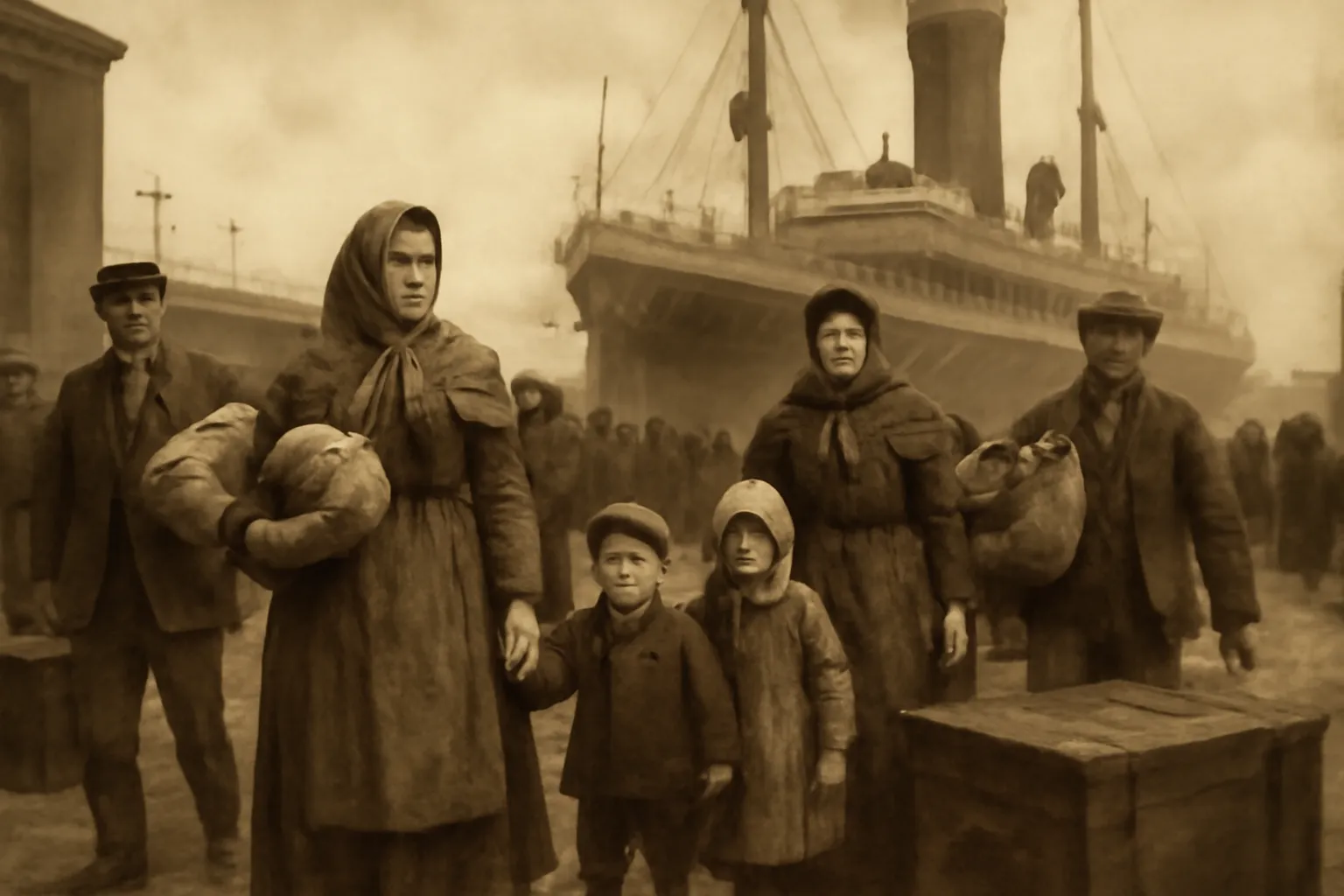
The journey from a Galician village to the Canadian prairies was an ordeal that tested every immigrant's endurance and resolve. The entire trip typically took three to six weeks and involved multiple stages, each with its own challenges.
Stage 1: From the Village to the Port
Emigrants typically traveled by horse cart to the nearest railway station, then by train across the Austro-Hungarian Empire and Germany to one of the major North Sea ports: Hamburg, Bremen, or occasionally Antwerp or Liverpool. The overland journey could take several days and required navigating unfamiliar cities, changing trains, and passing through border controls.
At the ports, emigrants were processed through emigrant halls (Auswandererhallen) where they underwent medical inspections, had their documents checked, and waited -- sometimes for days -- until their ship was ready to depart. The Hamburg emigrant halls, known as BallinStadt (named after Albert Ballin, director of the Hamburg America Line), could accommodate thousands of people and included dormitories, dining halls, and even churches and synagogues.
Stage 2: The Atlantic Crossing
Most Ukrainian immigrants traveled in steerage class -- the cheapest accommodation, located in the lowest decks of the ship. Conditions were crowded, poorly ventilated, and often unsanitary. Passengers slept in bunks stacked three or four high, shared communal toilets, and ate simple meals in common dining areas. Seasickness was almost universal, and the crossing could take 10 to 14 days depending on weather conditions.
Despite the hardships, the journey was also a transformative experience. For peasants who had never traveled more than a few kilometres from their village, the ocean crossing was a passage between worlds -- leaving behind everything familiar and heading toward a future that was as terrifying as it was promising.
Stage 3: Arrival at a Canadian Port
Ukrainian immigrants arrived at different Canadian ports depending on the period. Early arrivals (1891-1920s) typically landed at Quebec City, while later immigrants (1928-1971) arrived at Pier 21 in Halifax. At the port, they underwent medical inspections and immigration processing. Those deemed unfit -- due to disease, disability, or other grounds -- could be denied entry and sent back to Europe, a devastating outcome after such a difficult journey.
Arrival in Canada
Upon clearing immigration, Ukrainian settlers faced another journey of several days by train to reach the prairies. The Canadian Pacific Railway transported immigrants westward in colonist cars -- basic rail cars with wooden benches that could be converted into sleeping berths. The journey from Quebec City or Halifax to Winnipeg took approximately four days, and from Winnipeg to the final destination in Alberta or Saskatchewan, another day or two.
Arriving at a remote railway siding in the middle of the prairie, many immigrants experienced a profound shock. The landscape bore no resemblance to the rolling hills, forests, and villages of Galicia. The prairie was flat, treeless, and seemingly endless. There were no houses, no roads, no neighbours. For families accustomed to the close-knit village life of Eastern Europe, the isolation was overwhelming.
Yet the soil was rich, and the land was theirs. Families who had never owned more than a few hectares were now stewards of 160 acres. The work of transforming raw prairie into productive farmland would take years of backbreaking labour, but the promise was real.
Settlement Patterns: Bloc Settlements
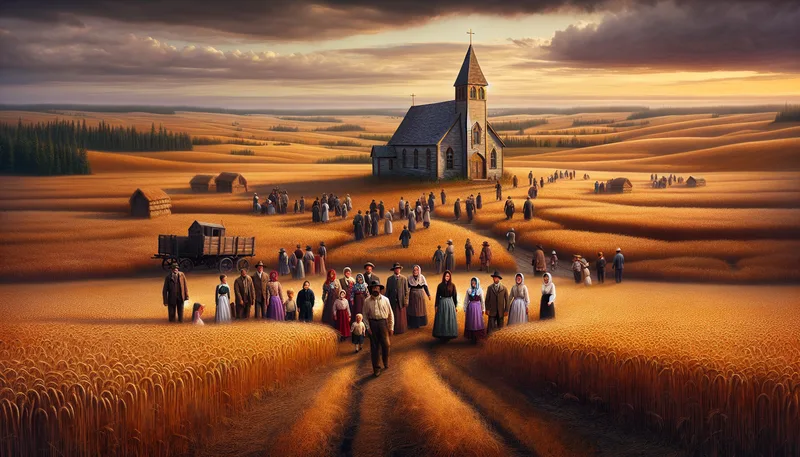
Ukrainian immigrants did not scatter randomly across the prairies. Instead, they formed bloc settlements -- concentrated communities where families from the same region of Galicia (and often the same village) settled on adjacent homesteads. This pattern was partly deliberate (families chose land near relatives and fellow villagers) and partly the result of Canadian government policy, which designated specific areas for Eastern European settlement.
Major Bloc Settlements
- Edna-Star district, Alberta -- one of the earliest and largest Ukrainian bloc settlements, northeast of Edmonton. By 1900, thousands of Ukrainian families had homesteaded in this area, creating a landscape that closely replicated the village patterns of Galicia.
- Dauphin district, Manitoba -- a major centre of Ukrainian settlement in the parkland belt of Manitoba. The annual Canada's National Ukrainian Festival in Dauphin celebrates this heritage.
- Yorkton-Canora district, Saskatchewan -- another significant concentration of Ukrainian homesteaders, with a strong institutional presence of Ukrainian churches, schools, and community halls.
- Vegreville district, Alberta -- home to one of Canada's most famous Ukrainian symbols, the giant Pysanka (Easter egg) monument.
The bloc settlement pattern had profound consequences for the preservation of Ukrainian culture in Canada. Living in concentrated communities, Ukrainian settlers maintained their language, religious practices, folk traditions, and social customs far longer than they might have in more dispersed settlements. Churches, schools, and community halls became the institutional anchors of these communities, providing social services, education, and a sense of cultural continuity that sustained families through the difficult early years.
Building a New Life on the Prairie
The first years on the homestead were the most difficult. Families arrived with little money and few tools. The immediate priorities were shelter, water, and breaking the land for the first crop.
Building the First Home
In areas with available timber, settlers built log houses similar to those they had known in Galicia. They used construction techniques passed down through generations: logs were hewn and notched at the corners, gaps were filled with moss and clay, and the exterior was often whitewashed with lime. In treeless prairie areas, families initially lived in sod houses (burdei) -- semi-underground shelters dug into the earth with sod walls and a thatched or sod roof. These primitive structures were dark, damp, and infested with insects, but they provided protection from the extreme prairie winters.
Breaking the Land
The prairie sod was thick with deep-rooted grasses that had never been plowed. Breaking the sod required immense physical effort. Many Ukrainian settlers, unable to afford horses or oxen in their first years, broke the land by hand using spades and hoes. Some families hitched themselves to the plow. Progress was agonizingly slow: a strong man might break one to two acres per day. The Canadian government required homesteaders to cultivate a minimum of 15 acres within three years to receive their land patent.
Surviving the Winters
Nothing in Galicia could have prepared the settlers for a Canadian prairie winter. Temperatures dropped to minus 30 or minus 40 degrees Celsius. Blizzards could last for days, making it impossible to venture outdoors. Fuel was scarce -- settlers burned dried buffalo chips, twisted straw, and whatever wood they could gather. Livestock that had been purchased at great expense could freeze to death if shelters were inadequate. The isolation was profound: the nearest neighbour might be miles away, and the nearest town a day's journey by horse.
The Role of the Church
For Ukrainian settlers, the church was far more than a place of worship. It was the centre of community life, the keeper of cultural identity, and the institution that provided continuity between the old world and the new.
The majority of Ukrainian immigrants from Galicia were Ukrainian Catholic (Greek Catholic), adhering to the Eastern rite while maintaining union with Rome. A smaller number were Ukrainian Orthodox, primarily from Bukovina and the Russian Empire. In Canada, both denominations established parishes as quickly as possible, often before there were even enough families to fill a church.
The distinctive onion-domed churches that dot the prairie landscape are the most visible legacy of Ukrainian settlement. Many of these churches were built by the settlers themselves, using the same log construction techniques they had brought from Galicia. The interiors were painted with icons and decorated according to Byzantine tradition, creating sacred spaces that transported worshippers back to the churches of their homeland.
The church also served as a school, community hall, and social centre. In the absence of government-funded schools (which were slow to reach remote homesteading areas), churches provided the first education available to Ukrainian children on the prairies. Priests taught reading and writing in Ukrainian, religious catechism, and basic arithmetic. These church schools played a crucial role in preserving the Ukrainian language among the first Canadian-born generation.
Community Leaders and Early Organizations
The early Ukrainian community in Canada produced remarkable leaders who worked to organize, educate, and advocate for their fellow immigrants. These individuals built the institutional infrastructure that sustained Ukrainian-Canadian culture through the 20th century.
Cyril Genik
Cyril Genik arrived in Winnipeg in 1896 and was appointed as the first Ukrainian-speaking immigration agent by the Canadian government. Genik met arriving immigrants at the Winnipeg immigration hall, helped them navigate the homestead registration process, and directed them to established Ukrainian settlements. His role was invaluable: he served as an interpreter, adviser, and advocate for thousands of newly arrived families who spoke no English and knew nothing of Canadian bureaucracy.
Early Newspapers and Cultural Organizations
The first Ukrainian-language newspaper in Canada, Kanadyiskyi farmer (Canadian Farmer), began publication in Winnipeg in 1903. It was followed by numerous other publications that served as lifelines for the scattered Ukrainian communities across the prairies. These newspapers published news from Ukraine, practical advice for homesteaders, and editorials on political and cultural issues. They also served as a communication network, publishing letters from settlers, notices about community events, and advertisements for Ukrainian-owned businesses.
Cultural organizations such as reading halls (chytalni) and the Ukrainian National Association provided education, mutual aid, and a sense of collective identity. These institutions were modeled on similar organizations in Galicia, where the Ukrainian national movement had been building community infrastructure since the mid-19th century.
The End of the First Wave: 1914
The outbreak of World War I in August 1914 brought the first wave of Ukrainian immigration to an abrupt halt. The Atlantic shipping lanes became war zones, and the Austro-Hungarian and Canadian governments both imposed restrictions on emigration and immigration. The approximately 170,000 Ukrainians who had arrived in Canada between 1891 and 1914 would now face a new set of challenges.
As subjects of the Austro-Hungarian Empire -- an enemy of Britain and its dominions -- Ukrainian Canadians were classified as "enemy aliens" during the war. Approximately 8,500 Ukrainians (along with other Austro-Hungarian subjects) were interned in 24 internment camps across Canada, where they were forced to perform hard labour in national parks and other work sites. Thousands more were required to register with the police and carry identity documents. Their property was sometimes confiscated, and their civil liberties were severely curtailed.
The internment experience was a profound injustice that scarred the Ukrainian-Canadian community for generations. It was not until 2005 that the Canadian government officially acknowledged the internment through the Internment of Persons of Ukrainian Origin Recognition Act.
The Legacy of the First Wave
The 170,000 Ukrainians who arrived in Canada between 1891 and 1914 laid the foundation for what would become one of the country's largest and most culturally vibrant ethnic communities. Today, approximately 1.4 million Canadians claim Ukrainian heritage -- a population that traces directly back to those pioneer families who left Galicia with little more than the clothes on their backs and the determination to build a better life.
The bloc settlements they established on the prairies evolved into thriving communities with churches, schools, co-operatives, credit unions, and cultural organizations. The Ukrainian language survived for generations in these communities, sustained by churches, newspapers, and the sheer concentration of Ukrainian speakers in the bloc settlements.
The cultural legacy is visible across the Canadian prairies: in the onion-domed churches that punctuate the landscape, in the vibrant folk dance and music traditions that thrive in cities like Edmonton, Winnipeg, and Saskatoon, and in the Ukrainian festivals, museums, and heritage sites that celebrate this remarkable story of migration and settlement.
For genealogists, the first wave of Ukrainian immigration is the anchor point of most Canadian-Ukrainian family research. Understanding the historical context -- the poverty of Galicia, Sifton's recruitment campaign, the transatlantic journey, and the settlement patterns on the prairies -- helps researchers interpret the documents they find and appreciate the extraordinary courage of the ancestors they are tracing. Those wishing to visit the ancestral villages of Galicia today can find practical resources at ukrainetrips.com. To learn more about the complete story of Ukrainian immigration to Canada, see our Ukrainian immigration timeline. For those whose ancestors were among the early settlers of the Maritimes, our article on Ukrainian settlers in Prince Edward Island explores this lesser-known chapter of the story.
Frequently Asked Questions
The first known Ukrainian immigrants to Canada were Ivan Pylypiw and Wasyl Eleniak, who arrived in September 1891 from the village of Nebyliv in the Kalush district of Galicia (then part of the Austro-Hungarian Empire). Their reports back to Galicia triggered the first wave of mass Ukrainian immigration.
The main push factors were extreme poverty, land pressure from overpopulation and subdivision of farms, heavy taxation, and political marginalization under Polish administration in the Austro-Hungarian province of Galicia. The pull factor was Canada's offer of 160 acres of free homestead land on the prairies, actively promoted by immigration agents and steamship companies.
Approximately 170,000 Ukrainians immigrated to Canada during the first wave (1891-1914). The vast majority came from the Austro-Hungarian province of Galicia, with smaller numbers from Bukovina and the Russian Empire. Most settled on homesteads in the prairie provinces of Alberta, Saskatchewan, and Manitoba.
Bloc settlements were concentrated Ukrainian communities where families from the same region of Galicia settled on adjacent homesteads. Major bloc settlements included the Edna-Star district in Alberta, the Dauphin district in Manitoba, and the Yorkton-Canora district in Saskatchewan. These communities preserved Ukrainian language, religion, and cultural traditions far longer than dispersed settlement patterns would have allowed.
Clifford Sifton served as Canada's Minister of the Interior from 1896 to 1905 and was the architect of Canada's aggressive immigration policy targeting Eastern European peasants. He famously described his ideal immigrant as "a stalwart peasant in a sheepskin coat" and directed immigration agents to recruit heavily in Galicia and other parts of the Austro-Hungarian Empire.
As subjects of the Austro-Hungarian Empire (an enemy of Britain and its allies), Ukrainian Canadians were classified as "enemy aliens." Approximately 8,500 Ukrainians were interned in 24 camps across Canada and forced to perform hard labour. Thousands more were required to register with police and carry identity documents. The Canadian government did not officially acknowledge this injustice until 2005.