Why Cyrillic Church Records Matter
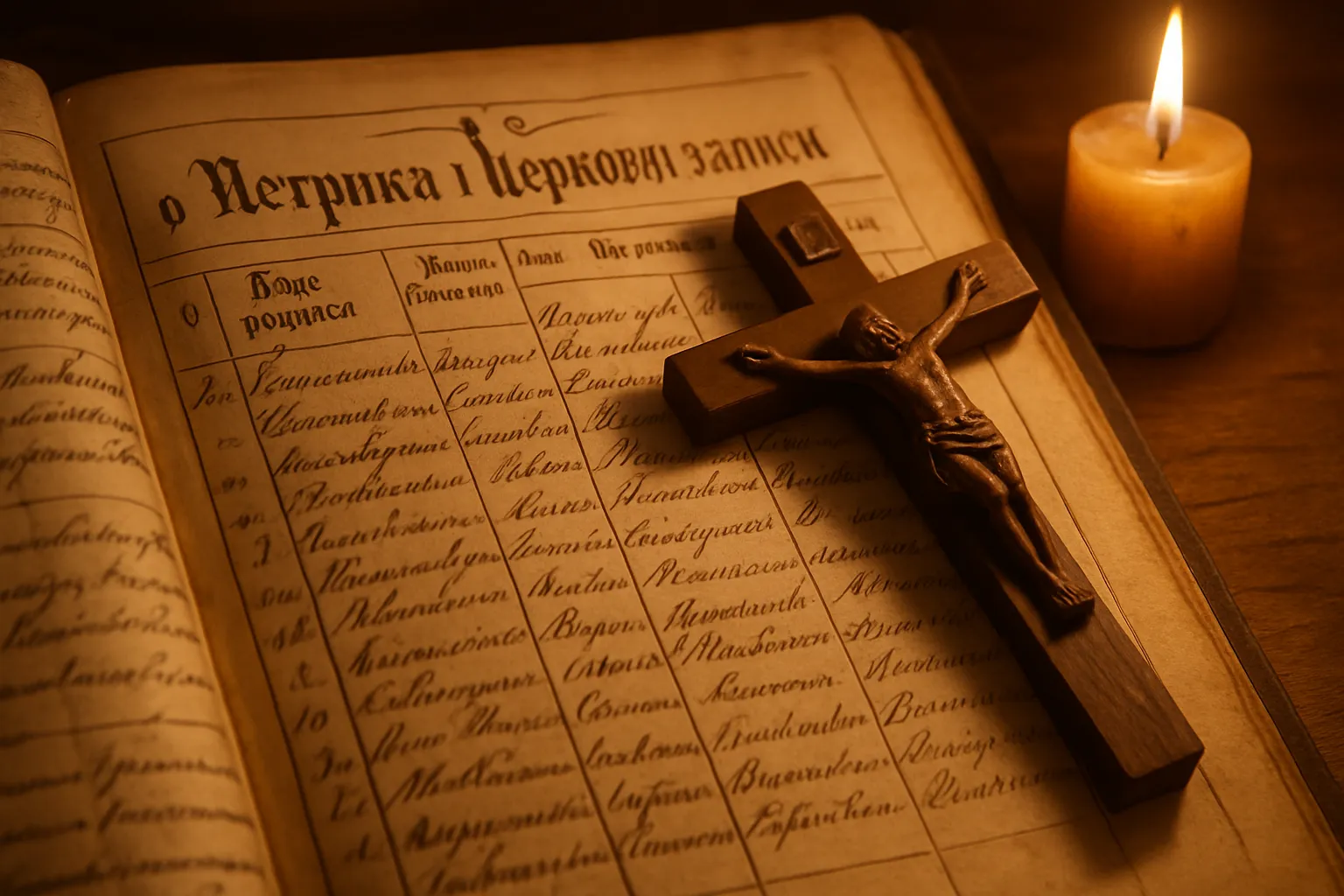
Church records -- known in Ukrainian as metrychni knyhy (metrical books) -- are the foundation of Ukrainian genealogy research for any period before the 20th century. These parish registers recorded the births, marriages, and deaths of parishioners in meticulous detail, creating a continuous record of family life that stretches back centuries in some parishes.
For genealogists whose ancestors came from the Russian Empire (central and eastern Ukraine), these records are almost exclusively written in Cyrillic script: a mix of Church Slavonic, Russian, and Ukrainian depending on the period, region, and individual priest. For those with roots in Galicia (western Ukraine), the situation is more complex -- records may be in Latin, Polish, German, or Cyrillic depending on the era and the denomination of the church.
The ability to read old Cyrillic church records opens a door that would otherwise remain permanently closed. With practice, patience, and the reference materials in this guide, researchers who do not speak Ukrainian or Russian can learn to extract essential genealogical data from these documents. You do not need to translate every word -- you need to recognize patterns, names, dates, and key vocabulary.
This guide focuses on the Cyrillic-script records most commonly encountered by Ukrainian genealogists: those from Orthodox parishes in the Russian Empire and Greek Catholic parishes in Galicia that used Cyrillic (or a mix of Cyrillic and Latin). For guidance on navigating the archives where these records are held, see our comprehensive guide to Ukrainian church records.

The Pre-Revolutionary Cyrillic Alphabet
The Cyrillic alphabet used in church records before the 20th century differs from the modern Ukrainian or Russian alphabets in several important ways. The pre-revolutionary Russian Cyrillic alphabet (used in official records across the Russian Empire, including Ukraine) contained letters that were eliminated by the Bolshevik spelling reform of 1918.
Obsolete Letters You Will Encounter
When reading church records from the Russian Empire (pre-1918), you will encounter these letters that no longer exist in modern Russian:
- Yat (resembling a lowercase "b" with a crossbar) -- pronounced like "ye" in most positions. Yat was used in hundreds of common words and is the most frequently encountered obsolete letter. In genealogical context, it appears in words like "viera" (faith), "dievitsa" (maiden), and many personal names.
- Fita -- pronounced like "f" or "th," used in words borrowed from Greek, such as "Feodor" (Theodore) and "Feodosia." In modern spelling, these words use the standard "F" (ef).
- I (decimal I, written like the Latin letter I) -- used before vowels and the letter "y" (short i). This letter was replaced by the standard Cyrillic "I" (ee) in the 1918 reform.
- Izhitsa -- a rare letter resembling the Latin "V," used in a handful of Greek-derived words. It had largely fallen out of use even before the 1918 reform.
- Hard sign (yer) -- in pre-revolutionary orthography, the hard sign was written at the end of every word that ended in a consonant. This means that virtually every noun, verb, and adjective in a church record will end with this letter. Do not confuse it with a substantive letter -- it is silent and can be ignored for transliteration purposes.
Numbers in Church Records
Most church records from the 18th and 19th centuries use Arabic numerals (1, 2, 3) for dates and ages, which is fortunate for researchers who cannot read Cyrillic. However, some older records -- particularly those from the 17th century and earlier -- use the Cyrillic numeral system, in which letters of the Cyrillic alphabet represent numbers. A titlo (a diacritical mark above the letter) indicates that a letter is being used as a numeral rather than a letter. This system is rarely encountered in the records most genealogists use, but be aware of it when working with very old documents.
Church Slavonic vs. Modern Ukrainian and Russian
Church records were written in several different languages and registers, often mixed within a single document. Understanding the linguistic landscape will help you identify what you are reading.
Church Slavonic
Church Slavonic (tserkovnoslavianska mova) was the liturgical language of the Eastern Slavic churches. It was not a spoken language but a written ecclesiastical language derived from Old Bulgarian and standardized for religious use. Church Slavonic appears most frequently in the formulaic portions of metrical books -- the printed column headers, standard phrases, and religious invocations. Priests copied these formulas verbatim from one entry to the next.
The good news for genealogists is that Church Slavonic formulas are highly repetitive. Once you learn to recognize a few standard phrases, you will see them repeated in every entry in the register. The specific genealogical data -- names, villages, dates -- is typically written in the vernacular (Russian or Ukrainian) rather than Church Slavonic.
Russian
In the Russian Empire, all official records -- including church metrical books -- were kept in Russian. Priests in Ukrainian-speaking parishes recorded their parishioners' information in Russian, regardless of the language spoken at home. This means that Ukrainian personal names were often Russified in the records: "Ivan" might appear as the Russian "Ioann," "Mykola" as "Nikolai," and "Petro" as "Piotr."
Ukrainian
In some parishes, particularly in the late 19th and early 20th centuries, priests began recording information in Ukrainian rather than (or alongside) Russian. This is more common in records from Galicia, where Ukrainian national consciousness was stronger and where Austrian law permitted the use of local languages in official documents. Ukrainian-language records use a slightly different alphabet and vocabulary than Russian ones.
Practical Implications
For the genealogist, the key implication is that you should not expect consistency. A single metrical book might contain entries where the same priest writes the same person's name differently on different pages -- sometimes in Russian form, sometimes in Ukrainian form, sometimes abbreviated, sometimes in full. Flexibility and pattern recognition are more important than perfect language skills.
Structure of Metrical Books
Metrical books follow a standardized format that was mandated by the governing authorities (the Russian Orthodox Synod in the Russian Empire, or the Austrian civil authorities in Galicia). Understanding this structure allows you to navigate an unfamiliar document quickly and locate the information you need.
Three Sections
Every metrical book is divided into three sections:
- Part One: Births (Rodivshiesia / Narodzhenni) -- records of births and baptisms
- Part Two: Marriages (Brakosochetavshiesia / Venchani) -- records of marriages
- Part Three: Deaths (Umershie / Pomerli) -- records of deaths and burials
Each section covers one calendar year and begins with a heading stating the parish name, the year, and the section title. Entries are numbered sequentially within each section, with separate numbering for males and females in the birth and death sections.
Column Format
Within each section, entries are recorded in a tabular format with standardized columns. The exact number and content of columns varied by period and region, but the general pattern is consistent. Each entry occupies one or more rows in the table, with information distributed across columns according to a fixed schema.
Reading Birth and Baptism Records
Birth records are typically the most detailed entries in metrical books and contain the most genealogically valuable information. A standard birth entry in a Russian Empire metrical book includes the following columns:
Column Structure
| Column | Content | Genealogical Value |
|---|---|---|
| 1 | Entry number (male/female counted separately) | Reference number for citation |
| 2 | Date of birth | Exact birth date |
| 3 | Date of baptism | Usually 1-3 days after birth |
| 4 | Name of the child | Given name (often the saint's name for the birth date) |
| 5 | Parents' names, social status, religion | Father's full name, occupation, village; mother's full name including maiden name |
| 6 | Godparents' names and social status | Godparents were usually relatives or close family friends |
| 7 | Name of the priest who performed the baptism | Identifies the parish |
What to Extract
Focus on columns 4, 5, and 6. The child's name (column 4) confirms you have the right family. The parents' information (column 5) is the core genealogical data: it gives you the father's full name, his village of residence, his social status (peasant, townsman, soldier, etc.), and the mother's full name including her maiden surname (recorded as "and his lawful wife [name], born [maiden name]"). Column 6 provides the godparents, who were often relatives from the same or neighbouring villages -- a valuable lead for extending the family tree.
Example Entry
A typical birth record might read (in translation): "On the 15th day of January was born, and on the 18th day of January was baptized, a child named Ioann. Parents: peasant of the village of Borshchivka, Grigory Stepanovich Kovalenko, of the Orthodox faith, and his lawful wife Anna Ivanovna, born Petrenko. Godparents: peasant of the village of Borshchivka, Feodor Grigorievich Kovalenko, and townsman's wife Maria Stepanovna Bondarenko."
From this single entry, you learn: the child's name and birth date, the father's name and patronymic (revealing the grandfather's name), the family's village and social status, the mother's maiden name, and the godparents' identities.
Reading Marriage Records
Marriage records are valuable because they typically contain the most information about both the bride and groom, including their ages, parents' names, and the names of witnesses.
Column Structure
| Column | Content | Genealogical Value |
|---|---|---|
| 1 | Entry number | Reference number |
| 2 | Date of marriage | Marriage date |
| 3 | Groom's name, age, social status, religion, village | Full identification of the groom |
| 4 | Bride's name, age, social status, religion, village | Full identification of the bride |
| 5 | Whether first, second, or third marriage for each | Indicates previous marriages |
| 6 | Witnesses (poruchitiely) | Often relatives of bride and groom |
| 7 | Name of priest | Identifies the parish |
Key Details
Marriage records often specify whether the bride is a "dievitsa" (maiden/unmarried woman) or a "vdova" (widow), and similarly whether the groom is a bachelor or widower. The ages of both parties are recorded, which allows you to estimate birth years even when birth records have not survived. When the bride or groom came from a different village or parish, that village is specified -- an extremely useful detail for tracking families across multiple communities.
Reading Death Records
Death records are generally the shortest entries in metrical books but still provide valuable genealogical information.
Column Structure
| Column | Content | Genealogical Value |
|---|---|---|
| 1 | Entry number (male/female counted separately) | Reference number |
| 2 | Date of death | Death date |
| 3 | Date of burial | Usually 1-3 days after death |
| 4 | Name, age, social status, village of the deceased | Full identification |
| 5 | Cause of death | Medical/historical context |
| 6 | Name of priest and cemetery | Confirms parish |
Causes of Death
The recorded causes of death can provide interesting historical context, though they should be interpreted with caution. Common causes include: "ot starost" (from old age), "ot likhoradki" (from fever), "ot vospaleniia legkikh" (from inflammation of the lungs / pneumonia), "ot rodov" (from childbirth), and "ot ospiy" (from smallpox). For infant deaths, the cause is often recorded simply as "ot slabost" (from weakness).
Common Abbreviations and Terms
Priests used many abbreviations in metrical books to save space and time. Recognizing these abbreviations is essential for reading entries efficiently.
Social Status Terms
- Kr. or Krest. -- krestianin (peasant), the most common designation in Ukrainian records
- Mieshch. -- mieshchanin (townsman / petty burgher)
- Dvor. -- dvorianin (nobleman)
- Svyashch. -- sviashchennik (priest)
- D. or Diiak. -- diakon or diiak (deacon or church reader)
- Sol. or Sold. -- soldat (soldier)
- Kaz. -- kazak (Cossack)
- Vosp. -- vospitannik (orphan / ward)
Religious Terms
- Pravoslavnago ispovedaniia -- "of the Orthodox faith"
- Zakonniaia zhena -- "lawful wife"
- Nezakonnorozhdennyi -- "illegitimate" (born outside marriage)
- Vospriemniki -- "godparents" (at baptism)
- Poruchitiely -- "witnesses" (at marriage)
- Dievitsa -- "maiden / unmarried woman"
- Vdova / Vdovets -- "widow / widower"
Place and Administrative Terms
- Selo -- village (the most common settlement type)
- Derevnia -- hamlet (smaller than a selo, typically without a church)
- Gorod -- city
- Uezd -- district (administrative division within a guberniia)
- Guberniia -- province (major administrative division of the Russian Empire)
- Prikhod -- parish
Julian to Gregorian Date Conversion
One of the most common sources of confusion in Ukrainian genealogy is the difference between the Julian and Gregorian calendars. Understanding which calendar a record uses -- and how to convert between them -- is essential for accurate dating.
Historical Context
The Julian calendar, introduced by Julius Caesar in 46 BCE, was the standard calendar throughout Christendom until 1582, when Pope Gregory XIII introduced the Gregorian calendar to correct the Julian calendar's accumulated astronomical error. Catholic countries adopted the Gregorian calendar relatively quickly, but Orthodox countries -- including the Russian Empire -- continued to use the Julian calendar until the 20th century.
This means that all church records from the Russian Empire are dated according to the Julian calendar. Galician records under Austrian rule, by contrast, use the Gregorian calendar, since Austria adopted the new calendar in 1582.
The Conversion Table
To convert a Julian calendar date to a Gregorian calendar date, add the appropriate number of days:
| Period | Days to Add |
|---|---|
| March 1, 1700 - February 28, 1800 | +11 days |
| March 1, 1800 - February 28, 1900 | +12 days |
| March 1, 1900 - February 13, 1918 | +13 days |
For example, a birth recorded on January 6, 1875 in a Russian Empire church record (Julian calendar) corresponds to January 18, 1875 on the Gregorian calendar. A marriage recorded on March 15, 1910 (Julian) corresponds to March 28, 1910 (Gregorian).
When Conversion Matters
Calendar conversion is important when you are correlating records from different systems. If an immigrant's Canadian marriage certificate says they were born on January 18, 1875, but the Ukrainian church record shows a birth on January 6, 1875, there is no discrepancy -- the dates are identical, just expressed in different calendars. Being aware of this difference prevents false conclusions about identity.
Soviet Russia adopted the Gregorian calendar on February 14, 1918 (which was February 1 under the Julian calendar). All records after this date use the Gregorian calendar.
Handwriting Challenges
Perhaps the greatest practical difficulty in reading old Cyrillic church records is deciphering the handwriting. Priests wrote in cursive Cyrillic script, which looks dramatically different from printed Cyrillic letters. The relationship between printed and cursive forms in Cyrillic is less intuitive than in Latin script, and some cursive letters bear almost no resemblance to their printed equivalents.
Learning Cyrillic Cursive
The most challenging aspect is that several cursive Cyrillic letters look similar to each other. For example:
- Cursive "t" can look like a Latin "m" with three humps
- Cursive "sh" looks like a Latin "m" with an additional hump
- Cursive "g" can resemble a Latin "z" or "2"
- Cursive "d" can look like a Latin "g" or "d"
The best way to learn Cyrillic cursive is through practice with actual documents. Start with records where you already know the names (because you found them in other sources), and use the known information as an anchor to decode the handwriting. Online paleography tutorials, such as those offered by FamilySearch and the East European Genealogical Society, provide excellent practice materials with answer keys.
Variability Between Priests
Every priest had his own handwriting style, and some were significantly more legible than others. You may find that one priest's handwriting is easy to read while his successor's is nearly impossible. If you are struggling with a particular set of records, try looking at records from a different year (and therefore possibly a different priest) to calibrate your reading skills, then return to the difficult ones.
Dealing with Damaged Records
Old church records are often damaged by water, mold, insects, fire, or simple age. Pages may be torn, stained, or faded to near-illegibility. When working with damaged records, try adjusting the brightness and contrast of digital images. Software tools like Adobe Photoshop, GIMP (free), or even the basic editing tools in your phone's photo app can dramatically improve readability by darkening faded ink and lightening stained paper. Ultraviolet photography, while not practical for most genealogists, can reveal text that is invisible under normal light.
Latin-Script Records in Galicia
Genealogists with ancestors from Galicia (western Ukraine) will encounter a different record-keeping tradition. Under Austrian rule, Greek Catholic parish registers were often maintained in Latin script, using either Latin (the language), Polish, or German for the column headers and formulaic text.
Latin-Language Records
Many Greek Catholic metrical books from the 18th and early 19th centuries use Latin as the language of record. Column headers appear as: "Nomen baptizati" (name of the baptized), "Parentes" (parents), "Patrini" (godparents), "Locus" (place), etc. Names are Latinized: Ivan becomes "Joannes," Mykola becomes "Nicolaus," Anna remains "Anna." Villages are often given their German or Polish names rather than Ukrainian.
Polish-Language Records
After the Ausgleich of 1867, which gave greater autonomy to the Polish administration of Galicia, church records increasingly shifted to Polish. Column headers appear as: "Imie ochrzczonego" (name of the baptized), "Rodzice" (parents), "Chrzestni" (godparents). Ukrainian names are Polonized: Ivan becomes "Jan," Mykhailo becomes "Michal," Petro becomes "Piotr."
For guidance on accessing these archives, see our detailed guide to the Lviv archives for genealogy research.
Practical Tips for Beginners
Reading old Cyrillic church records is a skill that improves with practice. Here are practical recommendations for getting started:
- Start with what you know. If you already have names and dates from Canadian records, use them to locate the corresponding entries in Ukrainian metrical books. Known information serves as a Rosetta Stone for deciphering unfamiliar handwriting.
- Focus on names first. Names are the most recognizable elements in a church record, even in unfamiliar script. Learn to spot your family surnames and given names in Cyrillic, and use them as anchors to orient yourself in the document.
- Use FamilySearch's record collections. Many Ukrainian church records have been microfilmed and digitized by FamilySearch.org. Their online viewer allows you to browse page by page, zoom in on details, and adjust image quality. Some collections also have community-created indexes that can point you to the right page.
- Join a paleography study group. Organizations like the East European Genealogical Society (EEGS) and various online genealogy forums offer workshops and study groups focused on reading Cyrillic documents. Learning alongside others accelerates your progress and provides access to experienced mentors.
- Create a personal reference sheet. As you work through records, build a reference sheet of the handwriting patterns you encounter. Write down how each priest forms specific letters and abbreviations. Over time, your reference sheet becomes a personalized decoding tool.
- Be patient with yourself. The first record you attempt to read may take an hour or more. The fiftieth will take five minutes. The skill is cumulative, and every hour you invest pays dividends in future research sessions.
- Use multiple sources in parallel. Cross-reference church records with other genealogical sources -- censuses, revision lists, conscription records -- to verify your readings. If a name looks like it could be "Grigory" or "Georgy," checking other records for the same person may resolve the ambiguity.
Learning to read old Cyrillic church records is one of the most challenging -- and most rewarding -- skills a Ukrainian genealogist can develop. These documents hold the names, dates, and family connections that tie modern diaspora families to their ancestral villages. With the tools and techniques in this guide, you have everything you need to begin unlocking these records. The ancestors recorded in those fading pages have waited generations to be found. The work begins with the first letter you learn to read.
Frequently Asked Questions
No. You do not need fluency in either language. Church records follow standardized formats with repetitive formulas. By learning the Cyrillic alphabet, key vocabulary (about 50-100 words), and common abbreviations, you can extract names, dates, villages, and family relationships from most entries. Pattern recognition is more important than language fluency.
Church Slavonic is an ancient liturgical language derived from Old Bulgarian, used in Eastern Orthodox and Greek Catholic church services and documents. It is not a spoken language. Ukrainian is a modern Slavic language spoken by Ukrainians. Church records typically use Church Slavonic for formulaic headings and phrases, while the actual genealogical data (names, villages, occupations) is recorded in Russian or Ukrainian vernacular.
Add the appropriate number of days depending on the century: +11 days for the 18th century (1700-1799), +12 days for the 19th century (1800-1899), and +13 days for the early 20th century (1900-1918). For example, a birth recorded as January 6, 1875 on the Julian calendar corresponds to January 18, 1875 on the Gregorian calendar. Records from Galicia (under Austrian rule) already use the Gregorian calendar.
Metrical books (metrychni knyhy) are parish registers that record births/baptisms, marriages, and deaths. They are divided into three sections, one for each type of event. Originals are held in Ukrainian state archives (Lviv, Kyiv, Ternopil, etc.) and Polish state archives. Many have been microfilmed by FamilySearch.org and are available online for free. Some are also accessible through the Ukrainian archives' own digitization projects.
Names were adapted to the language of the record. In Russian Empire records, Ukrainian names were Russified (Mykola became Nikolai, Petro became Piotr). In Galician records, names were Polonized (Ivan became Jan) or Latinized (Ivan became Joannes). The same person might appear as Joannes in a Latin-language baptismal record, Jan in a Polish marriage record, and Ivan in a Ukrainian-language death record. Recognizing these equivalents is essential.
Start by studying a Cyrillic cursive alphabet chart, then practice with actual church records where you already know the names from other sources. FamilySearch and the East European Genealogical Society offer free paleography tutorials with practice exercises. Join online study groups where experienced researchers can help you decode difficult passages. The skill improves dramatically with practice -- expect the first few records to be very slow, but speed increases rapidly.