Why This List Exists
Ukrainian genealogy resources are scattered across four languages, three continents, and a fragmented mix of free and paid services. A typical first-time researcher spends weeks just finding out what is available. This guide consolidates the 20 most useful online resources for Ukrainian genealogy in 2026, ranked by their practical usefulness for Ukrainian-Canadian descendants tracing the first migration wave (1891-1914).
The list is organised by what each resource actually does: Canadian record sets, Galician archives, ship manifests, gazetteers, paleography aids, DNA databases, and community resources. Resources are described with their access model (free or paid), what they cover, and the typical use case where they are most valuable.
Tier 1 — The Core Resources Everyone Needs
These four resources are the backbone of any Ukrainian-Canadian genealogy project. If you only ever use four websites, use these.
1. Library and Archives Canada (bac-lac.gc.ca) — Free
Library and Archives Canada is the single most important resource for the Canadian side of Ukrainian genealogy. It provides free public access to:
- The 1901, 1906, 1911, 1916, and 1921 Canadian censuses
- Naturalisation records for 1915-1944
- Quebec City and Halifax passenger lists from 1865 to 1935
- Soldiers of the First and Second World Wars
- Land grant and homestead records (with reels for Saskatchewan and Manitoba homesteads especially valuable)
The interface is functional rather than slick, but the records are entirely free, the original images are downloadable in high resolution, and the holdings are exhaustive. Start here for any Canadian-side question.
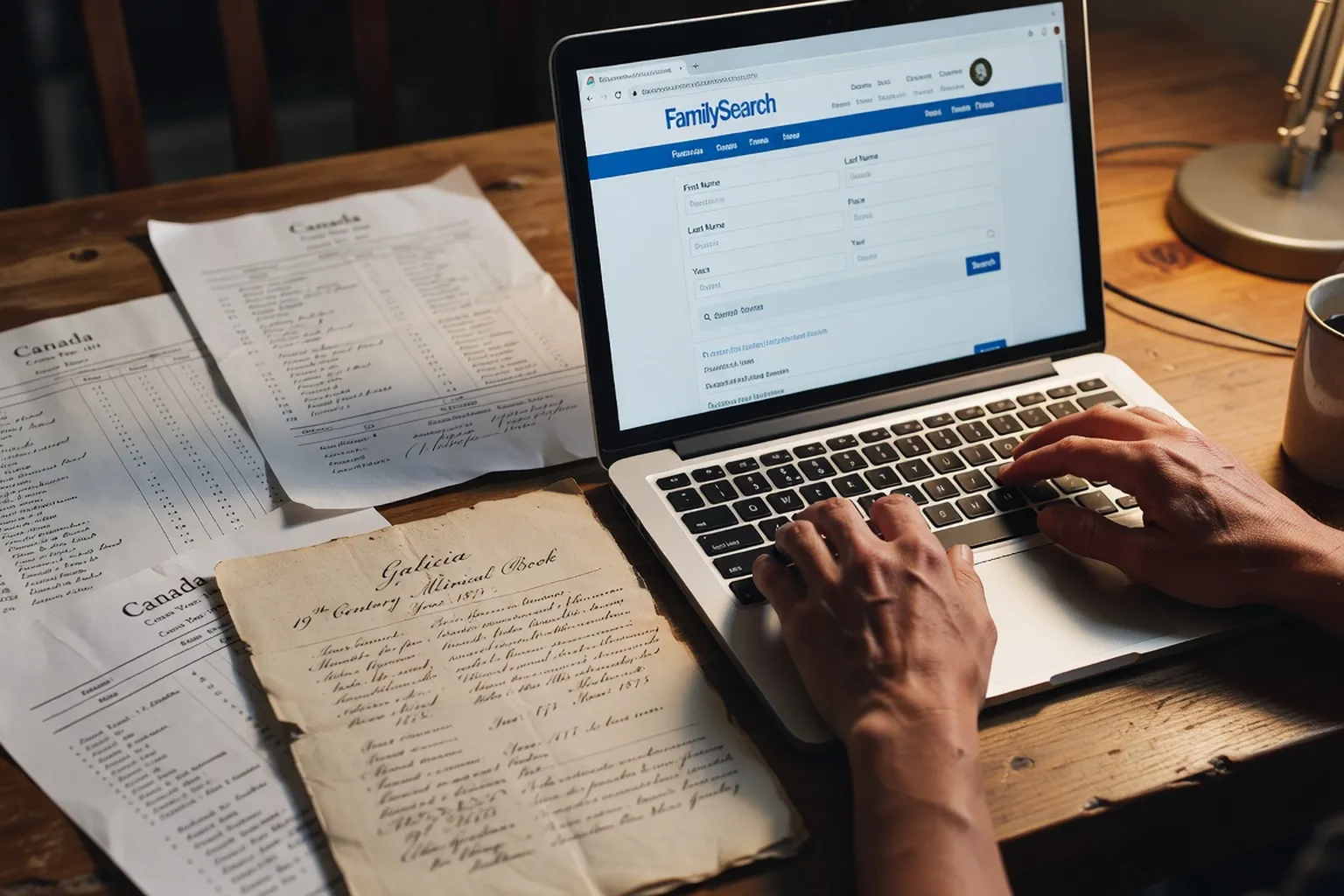
2. FamilySearch.org — Free with registration
FamilySearch is operated by the Church of Jesus Christ of Latter-day Saints and is the single most important free resource for the Ukrainian side of the research. It provides:
- Digitised Greek Catholic and Roman Catholic metrical books from Galicia (parishes vary by coverage)
- Indexed Canadian census records (often more searchable than LAC’s own indexes)
- Ship passenger lists indexed by name and arrival port
- A research wiki with country-specific guides for Ukraine, Galicia, and Bukovyna
- A FamilyTree collaboration platform for sharing trees
For Ukrainian genealogy specifically, the Galician parish microfilms that FamilySearch produced in the 1990s are irreplaceable. Many of them are now scanned and viewable online without leaving home.
3. The Lviv State Historical Archives (TsDIAL) — Email-based
The Lviv State Historical Archives holds the original Greek Catholic and Roman Catholic metrical books for Galicia. While it does not have a searchable online catalogue in the same form as Western archives, it does accept email research requests.
For records that have not been digitised by FamilySearch, this is the only path. Our Lviv archives guide walks through how to write a request, what the typical fees are, and what to expect.
4. Geneteka.genealodzy.pl — Free, Polish-language
Geneteka is the flagship Polish genealogy database. It indexes hundreds of thousands of births, marriages, and deaths from Polish, Galician, and former Polish-Lithuanian Commonwealth parishes, including many Greek Catholic and Roman Catholic parishes in Galicia.
The interface is in Polish but is straightforward enough that English-speaking researchers can navigate it with browser auto-translation. For any Galician parish that Geneteka covers, this is a faster first search than direct archive correspondence.
Tier 2 — Specialised Canadian Resources
5. Pier 21 (pier21.ca) — Free
The Canadian Museum of Immigration at Pier 21 (Halifax) maintains an online passenger arrival database that complements LAC’s holdings. For arrivals at Halifax, the Pier 21 search is often more user-friendly than the LAC equivalent.
6. Saskatchewan Homestead Records (sain.scaa.sk.ca) — Free
The Saskatchewan Homestead Index is essential for tracing Ukrainian settlers who took up land in the province under the Dominion Lands Act. It records the file number, location, applicant name, and dates for every original homestead application. The actual files (often 30+ pages each) can be ordered for a fee.
7. Manitoba Genealogical Society (mbgenealogy.com) — Mixed (free and paid)
The MGS has the strongest collection of Ukrainian-Canadian community indexes for Manitoba, including indexes of Ukrainian Greek Catholic and Greek Orthodox parish records from the homesteading era. Membership is required for some indexes, but many basic finding aids are free.
8. Alberta Genealogical Society (abgenealogy.ca) — Mixed
The AGS holds extensive indexes of Alberta cemeteries, parish records, and homestead files. The Ukrainian-Canadian content is particularly strong for the Vegreville bloc and the Mundare-Smoky Lake region.
Tier 3 — Galician Archives and Polish-Language Databases
9. Genealogical Indexer (genealogyindexer.org) — Free
GenealogyIndexer aggregates OCR-searchable indexes of historical books, gazetteers, and yearbooks from Galicia, Bukovyna, Volhynia, and surrounding regions. It is particularly useful for finding individual surnames in pre-1939 publications. A search for a surname can return hits in 19th-century guidebooks, business directories, and court announcement bulletins.
10. Polish State Archives (szukajwarchiwach.gov.pl) — Free
The Polish State Archives holds many records that originated in the eastern Polish lands now in Ukraine (Galicia, Volhynia). The catalogue is fully digital and searchable in Polish. Many records are scanned and viewable online for free.
11. JewishGen (jewishgen.org) — Free with registration
While its primary focus is Jewish genealogy, JewishGen is also useful for non-Jewish Galician research because Galician villages were multi-ethnic. The KehilaLinks project documents many Galician villages with maps, photographs, and oral histories that have value for any researcher of the region.
12. Habsburg Empire Cadastral Maps (mapire.eu) — Free
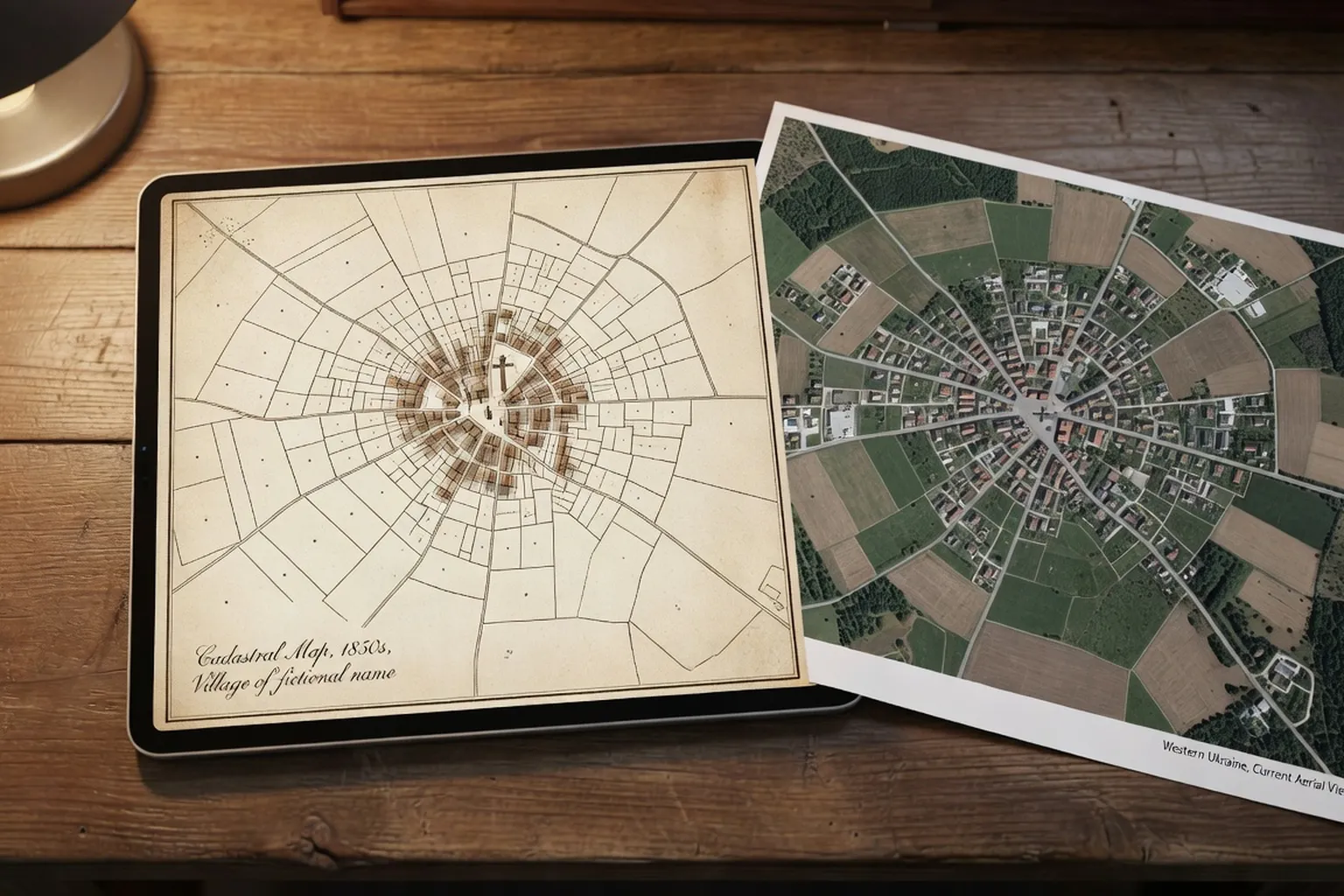
Mapire hosts digitised cadastral maps from the Austro-Hungarian Empire, including Galicia. You can find your ancestral village in its 1850s or 1860s state, with parcel boundaries, road layouts, and church locations. For visualising what your ancestors actually saw, nothing beats a contemporary cadastral map.
Tier 4 — DNA Databases
13. AncestryDNA — Paid
AncestryDNA has the largest consumer DNA database in the world (~25 million users). For Ukrainian research it offers Genetic Communities specifically for Galicia, Volhynia, and Ukrainian Settlers in the Canadian Prairies. The integration with Ancestry’s family tree platform is unmatched.
14. MyHeritage DNA — Paid
MyHeritage has a disproportionately European user base, which is valuable for Ukrainian researchers hoping to match with cousins still in Ukraine, Poland, or elsewhere in eastern Europe. Smart Matches and Theory of Family Relativity are useful automated analysis tools.
15. FamilyTreeDNA — Paid
FamilyTreeDNA specialises in Y-DNA and mtDNA haplogroup analysis. For researchers interested in deep ancestry beyond the genealogical timeframe — looking at Slavic, Cossack, or Carpathian male lines, for example — FamilyTreeDNA is the standard.
16. GEDmatch (gedmatch.com) — Free
GEDmatch is a free third-party platform where you can upload raw DNA data from any major testing company and compare against users from all services. It breaks down the walls between proprietary databases. Advanced tools like admixture calculators and chromosome browsers are available.
For a fuller comparison of these four DNA platforms specifically for Ukrainian ancestry, see our Ukrainian DNA testing guide.
Tier 5 — Tools and Aids
17. Cyrillic Paleography Tools
Reading 19th-century Cyrillic and Latin handwriting is a skill that takes practice. Two free resources help:
- The FamilySearch Wiki has a Latin Genealogical Word List that covers the abbreviations and terms common in Galician metrical books
- The Brigham Young University Script Tutorial at script.byu.edu teaches reading old Slavic and Germanic scripts
For Ukrainian Cyrillic specifically, our companion guide on reading old Cyrillic church records is structured around the most common letter forms and abbreviations researchers will encounter.
18. Google Translate and DeepL — Free
For rough translation of Ukrainian, Polish, and Russian web pages, DeepL is generally more accurate than Google Translate for these languages. Both are sufficient for navigation; neither is sufficient for translating handwritten documents.
19. Halgal.com — Free, English-language
Halgal is a long-running English-language resource centre for Galician and Bukovynian genealogy, maintained by Brian J. Lenius. It includes maps, gazetteer extracts, and research strategies that have introduced thousands of researchers to the field. Heavily oriented to North American descendants.
20. Ukrainian Genealogy Group PEI — Free
We are biased, but the Ukrainian Genealogy Group PEI is the principal community resource for Maritime descendants of Ukrainian immigrants. Beyond this article, the group offers:
- A library of guides covering Canadian immigration records, village name research, and community histories
- Member presentations and meetings
- Networking with researchers across the Maritimes
How to Combine These Resources Into a Workflow
A typical successful Ukrainian-Canadian genealogy project uses these resources in roughly this order:
- Start with oral history. Interview the oldest living relative.
- Move to Canadian records via Library and Archives Canada and FamilySearch — find the family in the 1906 Canadian census and locate the ship manifest.
- Identify the village using the manifest, gazetteers (Genealogical Indexer), and historical maps (Mapire).
- Search for digitised parish records on FamilySearch and Geneteka.
- Write to the Lviv archives for parishes not online.
- Use DNA testing to confirm and find unexpected branches once the paper trail is solid.
- Connect with community through groups like the Ukrainian Genealogy Group PEI for advice and networking.
The full workflow is described in detail in our companion guide on how to start Ukrainian genealogy research.
Resources to Avoid or Use With Caution
A few resources are popular but produce more confusion than clarity for Ukrainian research:
- Generic family-tree websites (WikiTree, Geni) often have user-submitted Ukrainian genealogy data that is inaccurate, especially for pre-1900 ancestors. Use them only for collaboration, not as primary evidence.
- Auto-translated foreign websites can mislead when the translation drops nuance. Verify any specific claim against the original-language source.
- For-profit Ukrainian “village expert” services with no track record. Some are excellent; many are predatory. Always check reviews and ask the Ukrainian Genealogy Group PEI or another community for vetting.
- AI-generated genealogies. ChatGPT and similar tools can hallucinate ancestors and dates. Use AI for translation and synthesis only, never as a source of factual claims.
Updates and What Has Changed in 2026
The biggest changes since 2024 have been:
- More Galician metrical books on FamilySearch. Coverage continues to expand as scanning projects complete.
- Slower archive response times because of the war in Ukraine. TsDIAL responses now average 4-12 months, up from 3-6 months pre-war.
- Better DNA database matching as the user base of European customers continues to grow on AncestryDNA and MyHeritage.
- Polish State Archives expansion. More 19th-century records from former Polish territories now in Ukraine are coming online.
Final Recommendation
If you have time for only three resources, use FamilySearch, Library and Archives Canada, and the Genealogical Indexer. Together they cover the entire arc from oral memory in Canada to a named village in Galicia, almost entirely for free.
If your research stalls, the Ukrainian Genealogy Group PEI and our comprehensive starting guide are the next places to go.
Frequently Asked Questions
FamilySearch. It contains digitised Greek Catholic and Roman Catholic metrical books from Galicia, indexed Canadian census records, ship passenger manifests for Quebec City and Halifax arrivals, and a wiki of country-specific research guides. Everything is free with a registered account.
No, but a paid subscription speeds the work up significantly. Library and Archives Canada and FamilySearch together cover the vast majority of Canadian and Galician records for free. Ancestry adds smart matching, integrated DNA results, and better cross-referencing across collections — useful but not essential.
Yes, with two assists. Modern browsers can auto-translate Ukrainian-language pages well enough to navigate. Google Translate handles short queries adequately. For old Cyrillic in metrical books, however, you need to recognise letter shapes and learn key terminology — automatic OCR rarely works on 19th century handwriting.
AncestryDNA has the largest database and the best Genetic Communities for Galicia and Volhynia. MyHeritage has stronger European user representation, including Ukrainian users. For Y-DNA and mtDNA haplogroup analysis, FamilyTreeDNA is the leading specialist. The detailed comparison is in our DNA testing guide.
The Genealogical Indexer at GenealogyIndexer.org indexes Polish-era gazetteers and yearbooks, including the 1934 Skorowidz miejscowosci Rzeczypospolitej Polskiej and similar works. The 1933 Gemeindelexikon der im Reichsrat vertretenen Konigreiche und Lander is also widely consulted. Both are free.
Look for an explicit last-updated date or a recent news section. FamilySearch and Library and Archives Canada update continuously and are essentially always current. Genealogy blogs and personal websites should be cross-checked against authoritative archive websites if their information is more than two years old.
AI tools are useful for translation, research planning, and synthesising context, but they should not be used to verify facts or to read handwriting. Always verify any AI-suggested fact against a primary source. AI can be helpful for drafting an inquiry email to a foreign archive in proper Ukrainian or Polish.